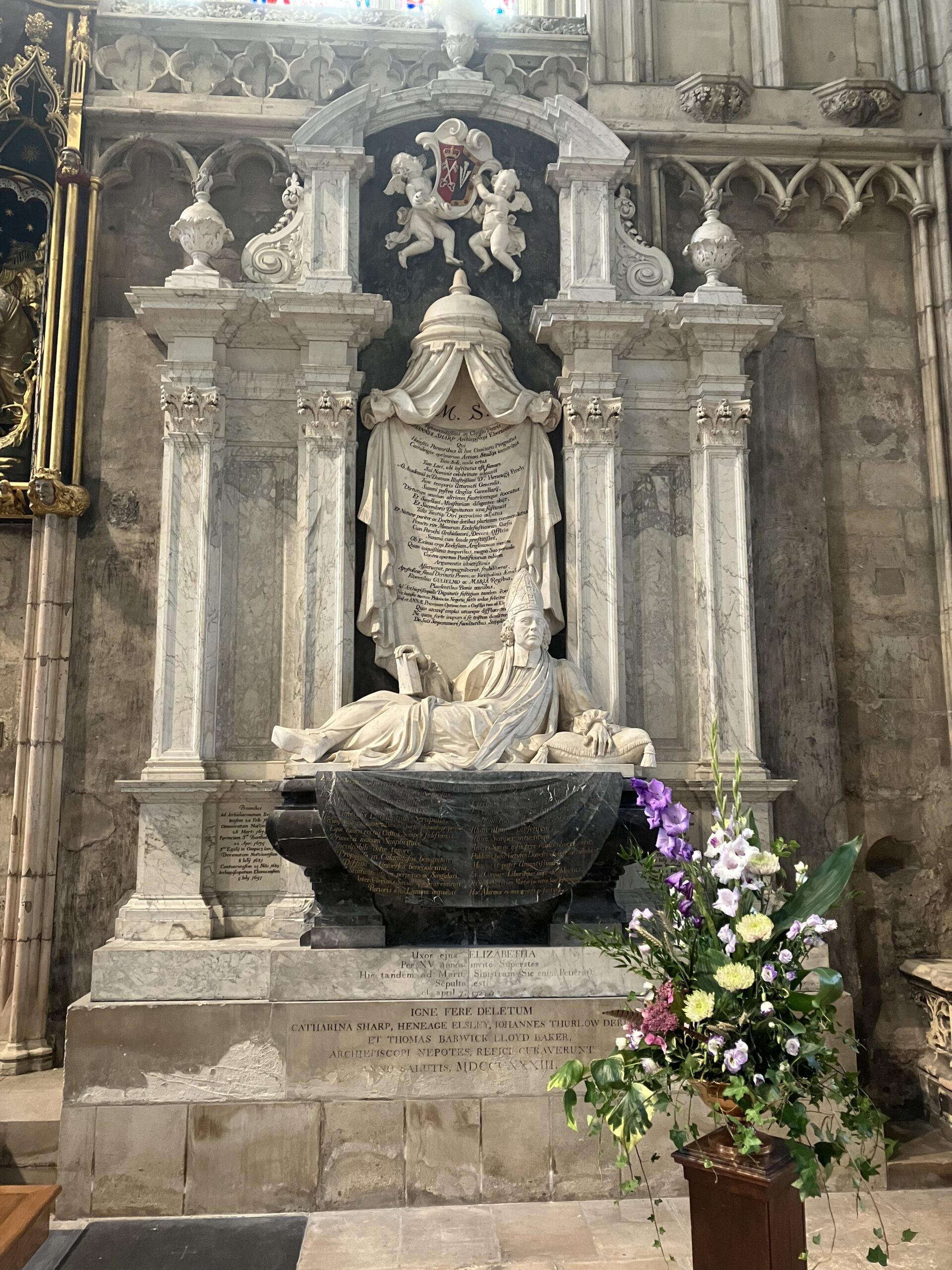
Sharp, John
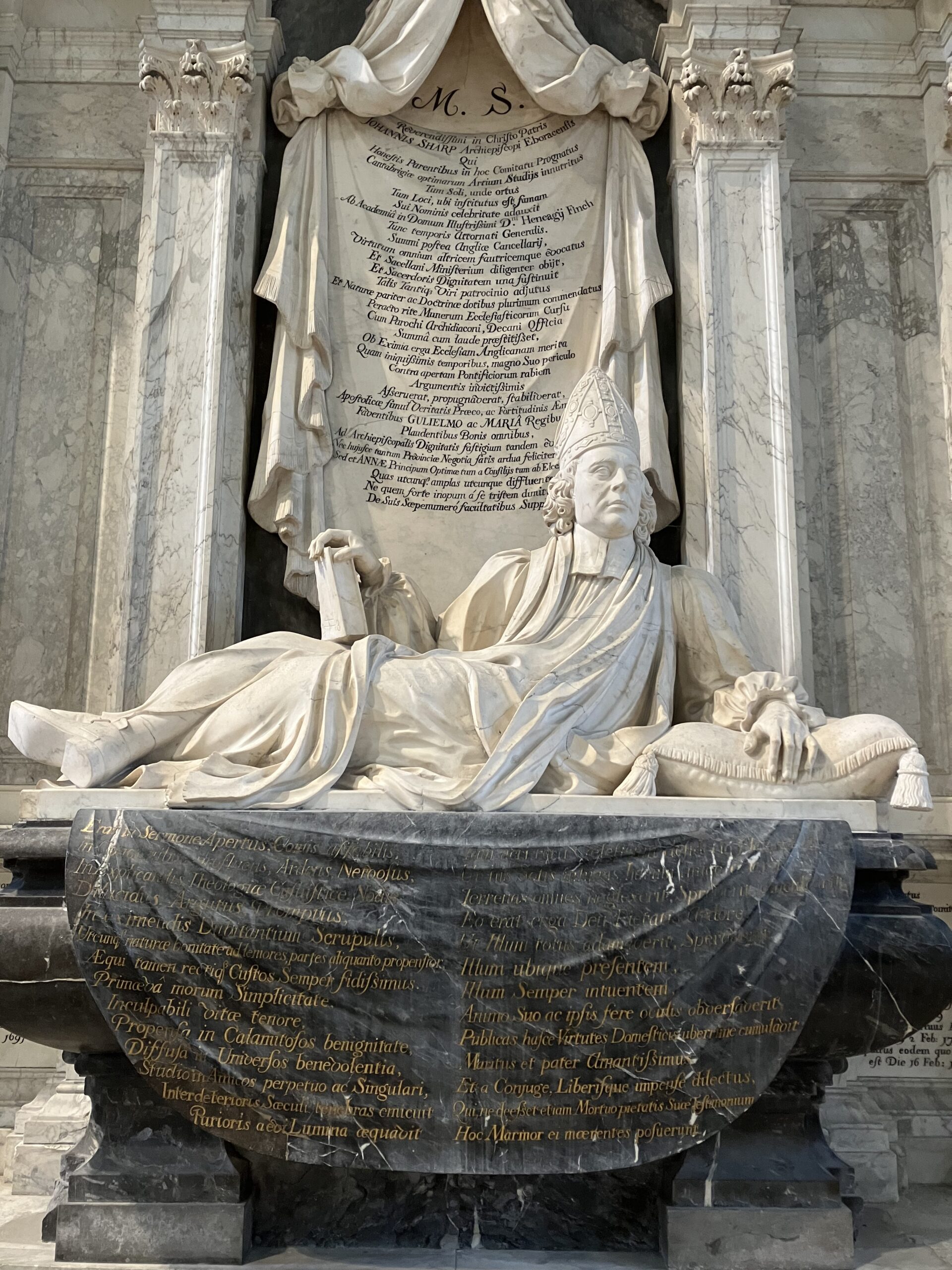
In Latin: [Above monument] Sacred to the memory of the most reverend father in God John Sharp, Archbishop of York, who being descended from a reputable family in this county, and bred to the study of polite literature in the university of Cambridge, added to the fame of the country where he was born, and of the places where he was educated, by his own great reputation. Being called from the university into the family of the illustrious Heneage Finch, then Attorney General, afterwards High Chancellor of England, where every virtue found encouragement and patronage, he diligently discharged the office of Chaplain, and at the same time acquitted himself honourably in the sacred duties of a more public and extensive charge. Supported by so great and excellent a patron, and powerfully recommended by the gifts of nature and learning alike, having regularly passed through the various offices of the church, and with the highest praise supported the characters of parochial minister, archdeacon and dean, for his important services to the Church of England, which in the most arbitrary and oppressive times, against the undisguised rage of the Papists, he with great hazard, but by invincible arguments, defended, vindicated and established, this preacher of Apostolic truth, and imitator of Apostolic fortitude, by the royal favour of William and Mary, and with the applause of all good men, was promoted to the highest dignity in the church, and consecrated Archbishop of this province. To the difficult-enough duties of this station he applied himself with the greatest success. He was Privy Councillor and Almoner to her excellent majesty Queen Anne, to whose bounty, great and diffusive as it was, that no poor man might leave his presence sorrowful, he often added, of his own.
[Under monument] In conversation he was open, courteous, and affable; in his preaching he was fluent, ardent and fervent; in solving the difficulties of casuistical theology, clear, subtle, and prompt; in removing the scruples of the doubtful, though inclined by the goodness of his temper to lenient measures, he was nonetheless always a most faithful guardian of equity and rectitude. By the primitive simplicity of his manners, by the blameless tenor of his life, by his by his ready benignity to afflicted, by his universally diffused benevolence, by his constant and singular concern for his friends, he shone, amidst the darkness of a less worthy age, with a glory equal to the lights of purer times. He burned with so sharp a desire for heavenly things, that panting for these only, covetous of nothing but these, he neglected despised and trampled under foot all that was worldly. So ardent was his piety towards God that he wholly loved him, breathed after him, observed him with his mind and almost with his eye as everywhere present, as always beholding. To these public virtues he added those of a domestic nature: a most loving husband and father, he was loved by his wife and children, who, unwilling that a testimony of their piety should be wanting to him dead, erected this marble to him, weeping.
Church: York Minster (in York, Yorkshire).
Sex:
Male.
Virtue(s):
Achievement/success*, Affability, Almsgiving*, Antiquity of manners*, Ardour, Benignity, Blamelessness*, Clarity, Constancy*, Courtesy, Diligence, Domestic virtues*, Eloquence*, Equity, Famed*, Fervour, Good friend, Good parent, Good spouse, Good to the poor, Goodness, Honoured*, Intelligence*, Learning/knowledge*, Love, Love of God*, Love of/service to church, Mercy*, Of repute*, Openness, Orthodoxy*, Piety, Rank*, Rectitude*, Simplicity of manners*, Subtlety, Universal benevolence*, Unworldliness*, Virtues in general*.
Language:
Latin.
Year of death: 1714.
Age at death: not given (classed as: Adult).